We spend our days chasing a ghost of perfection that never truly arrives and it leaves us feeling brittle and disconnected from our own homes. Your bedroom should not be a trophy room or a cold museum of modern trends but rather it should be a quiet sanctuary where your soul can finally exhale.
This is the heartbeat of the ancient Japanese philosophy known as Wabi-Sabi which invites us to stop fighting against time and start finding beauty in the weathered and the worn. When you bring this mindset into your sleeping space you are choosing to honor the honest cracks and the faded edges of your own story.
You are creating a spiritual retreat where the pressure to be perfect finally dissolves into the warmth of a grounded and meaningful life. This environment allows you to reconnect with your true self away from the noise of the external world.

The Essence of Wabi-Sabi Design Basics for a Soulful Retreat
Understanding Wabi-Sabi begins when you choose to value the history of an object over its price tag or its social media appeal. This philosophy grew out of the roots of Zen Buddhism and it centers on the three marks of existence which are impermanence and simplicity and nature.
Instead of searching for flawless symmetry you learn to appreciate the soul within a piece of raw timber or the way morning light dances across a wrinkled linen sheet. This approach naturally integrates the principles of biophilic design to create a habitat that supports your mental wellness by anchoring you to the raw elements of the earth.
Your bedroom serves as the ultimate canvas for this kind of spiritual healing because it is the place where you are most vulnerable and open to rest. By moving beyond the sterile boundaries of traditional minimalism you discover a space that has actual heartbeat and character.
Minimalism often feels clinical and detached but Wabi-Sabi feels like a warm embrace from the earth itself. It allows you to breathe deeply and accept the truth that your life does not need to be a polished performance to be incredibly sacred.
This style encourages us to embrace living finishes which are honest materials like unsealed copper or raw wood that develop a unique personality as they age alongside us. These surfaces record the passage of time and remind us of the beauty inherent in the cycle of life.
10 Inspiring Wabi-Sabi Bedroom Ideas for Inner Peace
The following ideas are designed to help you ground your drifting energy and create a space that feels deeply personal through the art of tactile minimalism. Each element works together to build a foundation for spiritual calmness and mental clarity.
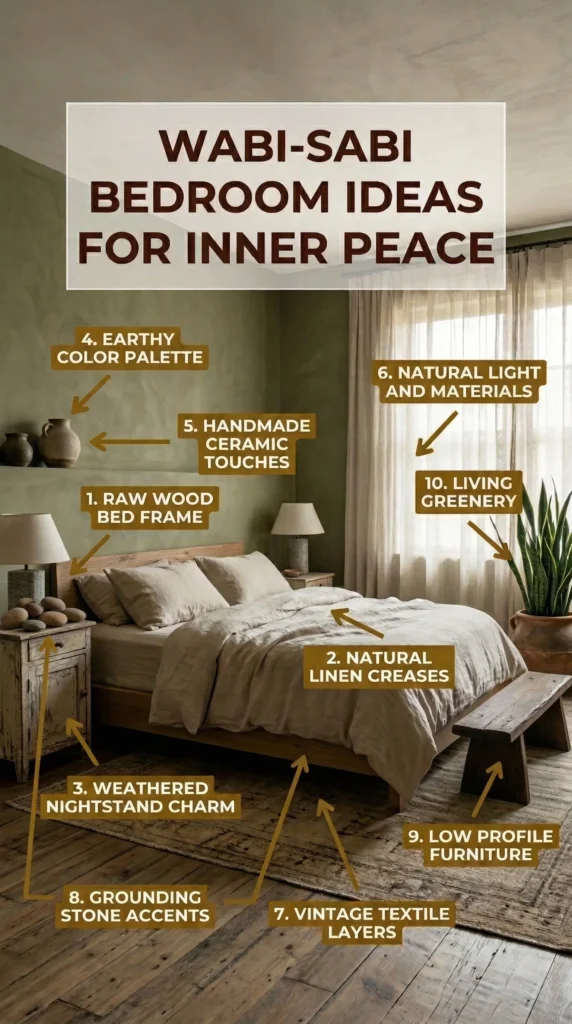
1. Rustic Wooden Bed Frame Grounding Your Energy
The foundation of any grounded room begins with a rustic wooden bed frame that acts as the heavy anchor for your rest. You should seek out the honest skeleton of White Oak or Reclaimed Elm because these timbers show the knots and grains of a life lived outdoors.
When you choose a frame with a live edge you are inviting the untamed spirit of the forest directly into your sanctuary. This raw aesthetic reminds you of your own resilience and natural roots.
This material serves as a thermal anchor and it helps regulate the energetic frequency of your sleeping area by providing a solid base that feels permanent and secure against the chaos of the world. The weight of the timber provides a sense of gravity that settles a racing mind.
2. Soft Linen Bedding Embracing Natural Creases
On top of that solid frame you should layer soft linen bedding made from high quality flax or sustainable organic hemp. One of the most beautiful aspects of linen is that it is meant to stay wrinkled and relaxed.
There is a profound spiritual comfort in seeing those natural creases because they remind us that we do not need to iron out every flaw in our daily lives. This texture invites you to be authentically yourself without the need for constant maintenance.
These natural fibers are also highly breathable and moisture wicking which supports a restorative sleep cycle by helping your body maintain a consistent and peaceful temperature throughout the night. The tactile sensation of the fabric against your skin promotes a state of deep sensory relaxation.
3. Weathered Nightstand Charm Finding Beauty in Age
Your nightstand does not need to be a matching piece from an industrial catalog. A weathered nightstand with a chipped corner or a faded stain carries a certain quiet dignity that brand new furniture lacks.
This aged patina tells a story of survival and it helps you feel more at peace with your own human aging process. Every scratch and mark serves as a witness to the passage of time and the beauty of endurance.
Choosing a piece with a history of use creates a sense of continuity and lineage within your home and it reminds you that true beauty is often found in endurance and the passage of time. It encourages you to find value in what is already present rather than always seeking the new.
4. Earthy Color Palette Tones of Tranquility
To keep the room feeling like a quiet retreat you should stick to an earthy color palette that mirrors the natural world. Think about the colors you find on a silent walk through the woods like sage green and burnt ochre and deep slate grey.
These tones are naturally soothing to the human nervous system and they provide a quiet backdrop for your daily meditation. They do not compete for your attention which allows your spirit to settle into the present moment.
Using limewash paints or clay plasters on the walls adds a tactile depth that feels like the inside of a safe natural cave and this provides a sense of primal safety from the outside world. The soft and matte finish absorbs light rather than reflecting it which creates an atmosphere of total stillness.
5. Handmade Ceramic Touches Celebrating the Human Element
Adding handmade ceramic touches like a slightly lopsided vase or a bowl repaired with gold brings a sense of human presence to the room. These pieces celebrate the Kintsugi spirit which is the powerful idea that we are stronger and more beautiful in the places where we have been broken.
Each piece of pottery carries the actual fingerprints of its creator and this organic energy helps combat the sterile and artificial feeling of our mass produced digital lives. It connects you to the tradition of craftsmanship and the humility of the human hand.
These objects do not need to be perfect to be functional or inspiring. Their asymmetry and unique glaze variations remind you that individual quirks are what make life meaningful and artful.
6. Sheer Curtains Harnessing Ma and Natural Light
Lighting is the most crucial element for a spiritual space so use sheer curtains to harness and filter the natural light. This creates a soft and ethereal glow that the Japanese call Ma which is the deep appreciation of the space between things.
It prevents the room from ever feeling harsh or clinical and it allows for a gentle transition from the noise of the day to the silence of the night. The dancing shadows cast by the fabric add a layer of dynamic and living art to your walls.
Softening the incoming light helps align your circadian rhythm and it makes the entire room feel like it is breathing in sync with the sun. This connection to the celestial cycles of light and dark is vital for spiritual grounding.
7. Vintage Textile Layers Storytelling Through Weaving
Vintage textile layers are another powerful way to bring history and depth into your sleeping space. A hand woven rug with a slightly frayed edge or a quilt passed down through family generations adds a layer of emotional heritage.
These items carry a frequency of care and history that mass produced items simply cannot replicate. They wrap your room in a sense of warmth and protection that feels like a shared ancestral memory.
Textiles made from natural fibers like wool and jute also improve the acoustic quality of the room by absorbing sharp sounds and creating a quietude that is necessary for deep spiritual reflection. The muffled silence helps you hear your own inner voice more clearly.
8. Stone Accents Grounding Stability from the Earth
Bring the physical weight of the earth inside by incorporating stone accents throughout your decor. A smooth river stone placed on a shelf or a rough granite lamp base provides a sense of permanent stability that wood alone cannot offer.
This helps ground your energy when your mind is racing with modern anxieties and digital distractions. The cool and solid touch of stone offers an immediate physical connection to the ancient world.
Stone is a cold and heavy element that provides a perfect counterpoint to the warmth of wood and the softness of fabric which creates a tactile balance that is central to the Zen aesthetic. It reminds you that the earth is always there to support you.
9. Low Profile Furniture Staying Close to the Floor
Low profile furniture is a staple of this style because it keeps you physically closer to the ground. There is a proven psychological benefit to staying close to the earth as it creates an immediate sense of stability and humility.
It changes the way you move through the room and encourages a slower and more deliberate pace of life. Being lower to the floor makes the ceiling feel higher and the space feel more open and liberated.
This lower center of gravity helps quiet the overactive mind and it reinforces the idea that we are part of the natural landscape rather than masters over it. It is a physical practice of letting go of ego and ambition.
10. Living Greenery Balancing Stillness with Vitality
Finally you must make sure to include living greenery to remind you of the cycle of growth. A single branch in a tall vase or a resilient potted plant provides a sudden burst of vitality amidst the stillness.
This balances the weathered and rustic elements with the fresh energy of something that is currently thriving. It serves as a visual metaphor for the ongoing renewal of your own spiritual journey.
Plants like Snake Plants or Peace Lilies are excellent for bedrooms because they purify the air while adding a soft and organic silhouette that breaks up the hard lines of the room. They represent the breath of life within your quiet sanctuary.
Designing a Zen Nook Creating a Spiritual Corner
Even a very small bedroom has enough space for a dedicated Zen nook where you can reconnect with yourself. You can set up a simple meditation altar with a few meaningful items like a single beeswax candle or a piece of found driftwood.
This corner acts as a spiritual anchor for your morning reflection and it gives your soul a home base within your house. It is important that this space remains separate from your work or storage areas so that your brain can immediately enter a state of relaxed focus.
Scent plays a massive role in how we perceive a space so choose mindful fragrances like sandalwood or cedar. Lighting a bit of natural incense can signal to your brain that it is time to shift out of work mode and into a state of deep rest.
When you pair this with a singing bowl or a set of Zen stones you create a sensory experience that grounds you in the present moment. This sensory layering is the key to making a space feel inhabited and sacred rather than just decorated for an audience.
Practical Wabi-Sabi Solutions for Small Bedroom Layouts
If you are working with a smaller room you might worry about the clutter but Wabi-Sabi teaches us to look at storage in a different way. You have to decide between hidden storage and open display based on what truly brings you peace of mind.
Open shelving can be beautiful if you only keep items that hold a deep personal meaning or a useful purpose. This approach requires a level of radical honesty about what you truly need and what is simply taking up emotional space in your life.
Multi functional pieces with primitive shapes are perfect for tight quarters where every inch matters. A simple wooden stool can serve as both a side table and a seat for your evening meditation.
By maximizing the flow of energy and focusing on the negative space you can make even the smallest room feel like a vast and open sanctuary. The goal is to create room for the soul to wander without being blocked by physical obstacles or the weight of visual noise.
Comparing Wabi-Sabi to Japandi and Traditional Minimalism
It is very easy to get Wabi-Sabi confused with Japandi or minimalism but there are key differences to keep in mind for your design. Japandi is a modern fusion that is often very clean and precise while Wabi-Sabi is much older and more ruggedly honest.
Traditional minimalism can sometimes feel like it is trying to hide the fact that actual humans live in the house. Wabi-Sabi celebrates the fact that you live there and it values the heritage of your items over clinical perfection.
While Japandi seeks a polished look for the eye Wabi-Sabi seeks a spiritual resonance that accepts the inevitable decay of all things. It is less about the appearance of order and more about the feeling of peace within the natural messiness of life.
Step-by-Step Guide How to Transition Your Room
- Identify the anchor of your space which is almost always the bed because it is the primary place of your spiritual restoration. You should begin by clearing away any distracting clutter from underneath or around the frame to allow the natural energy to circulate without being blocked.
- Practice radical curation by removing every object that feels like visual noise or does not serve a clear functional or spiritual purpose. This process of subtraction is much more powerful than adding new things because it reveals the hidden beauty of the space that remains.
- Swap your synthetic fabrics for organic alternatives like flax linen or hemp or raw cotton which feel better against the skin. You can begin with a single set of pillowcases and slowly build your collection as you become more comfortable with the new tactile sensations.
- Transform your walls with natural finishes like limewash or clay plaster to create a breathable and living skin for the room. These materials react to the shifting light throughout the day and create a subtle movement that feels much more alive than standard industrial paint.
- Integrate found objects from the natural world such as a piece of driftwood or a unique stone to serve as your anchors to the earth. Choosing objects that you personally discovered on a walk or a journey makes the decor feel deeply intimate and sacred to your heart.
- Adopt a Kintsugi mindset for your long term maintenance by choosing to repair meaningful items rather than throwing them away. This practice turns your lifestyle into a form of moving mindfulness that treats every scar as a mark of resilience and unique beauty.
Embracing the Journey Final Thoughts
Your bedroom is an evolving sanctuary and it will change and grow just as you do through the years. Accepting this change is the ultimate spiritual lesson that Wabi-Sabi offers us in our modern lives.
There is so much joy to be found in the cracks and the weathered edges of our lives if we are brave enough to stop hiding them. Embracing imperfection is the fastest path to genuine inner peace and spiritual fulfillment.
May your space become a place where the imperfect is honored and the soul is finally allowed to rest in its most natural and honest state. Let your home be a true reflection of your journey.
Common Questions About Wabi-Sabi Spiritual Decor
How do I tell the difference between Wabi-Sabi and a messy room?
Wabi-Sabi is defined by deep intentionality and the respectful care of objects that have aged naturally over time. A messy room is typically a collection of items that have been neglected or forgotten without any regard for their purpose or beauty.
In a Zen bedroom every piece should have a reason for being there even if that reason is simply to honor its history or its raw material. This distinction is important because the philosophy is based on mindful curation rather than simple disarray or a lack of effort on your part.
Can I still have a TV or modern tech in my Zen bedroom?
You certainly can integrate technology but the goal is to prevent it from becoming the dominant focal point of the spiritual room. You might consider hiding your TV behind a reclaimed wooden cabinet or using a hand woven cloth to cover your charging station during your rest hours.
This allows you to benefit from modern convenience while still protecting the sacred and low tech energy of your sleeping sanctuary. By creating these boundaries you ensure that your digital life does not interfere with your spiritual growth or your restorative sleep quality.
How do I maintain the space as a form of meditation?
Maintenance should be viewed as a daily ritual of gratitude rather than a burdensome household chore that you want to avoid. When you smooth your linen sheets or carefully dust your handmade ceramics do it with a sense of appreciation for the items that support your life.
This practice turns simple cleaning into a form of moving meditation that clears both your physical space and your internal mind. Over time you will find that the care you give to your environment is a direct reflection of the care you are giving to yourself.
Is it expensive to achieve this look?
Wabi-Sabi is actually one of the most sustainable and budget friendly styles because it encourages you to look for beauty in found objects. Instead of buying expensive new furniture you might find a unique piece at an antique market or use a smooth stone from a nearby river as a bookend.
The true value of a Wabi-Sabi item lies in its character and soul rather than its market price or a brand name. This approach allows you to build a high quality and deeply meaningful home without the need for excessive financial consumption or debt.
What are the best colors for a Wabi-Sabi bedroom?
The most effective colors are those that appear naturally in the landscape and help lower the heart rate for restorative rest. Off whites and muted greys and warm earth tones like terracotta or forest green create a neutral backdrop that feels organic and calm.
These colors do not compete for your visual attention and they allow your mind to enter a state of quietude the moment you walk through the door. Because these tones are inspired by nature they possess a timeless quality that never feels outdated or jarring to the human senses.
How does Wabi-Sabi help with sleep anxiety?
By removing the pressure to maintain a perfect aesthetic you lower the overall stress levels associated with your daily home environment. The use of raw and natural materials has been shown to reduce cortisol levels and the absence of visual clutter prevents the brain from being overstimulated.
This creates a low sensory environment that tells your nervous system it is safe to finally let go and rest deeply in the dark. When you are surrounded by materials that feel real and permanent your mind finds it much easier to enter a state of profound relaxation.